{"body":"On November 2026, a vulnerability in Optimizely's web experimentation platform let an attacker [serve malicious JavaScript](https://www.bleepingcomputer.com/news/security/optimizely-supply-chain-attack-delivers-malware-to-cnn-fox-news-bbc-salesforce-sites/) to visitors of at least 178 of the most popular organizations, including Zoom, Salesforce and the BBC, for roughly 17 hours before being detected.\r\n\r\nPasskey's \"gold standard\" reputation rests on phishing resistance, which depends wholly on a trusted login page. When that page runs attacker code, even a hardware-protected credential can authenticate a session issued to an attacker.\r\n\r\n**On a compromised page, a passkey sign-in can log the attacker in instead of the user, and Optimizely showed how realistic that is.**\r\n\r\nFor brevity, \"passkey\" here refers to the broader FIDO2 family, including hardware security keys. \r\n\r\nThe [ByPasskey demonstration](https://github.com/tide-foundation/ByPasskey) shows the result with a real passkey:\r\n\r\n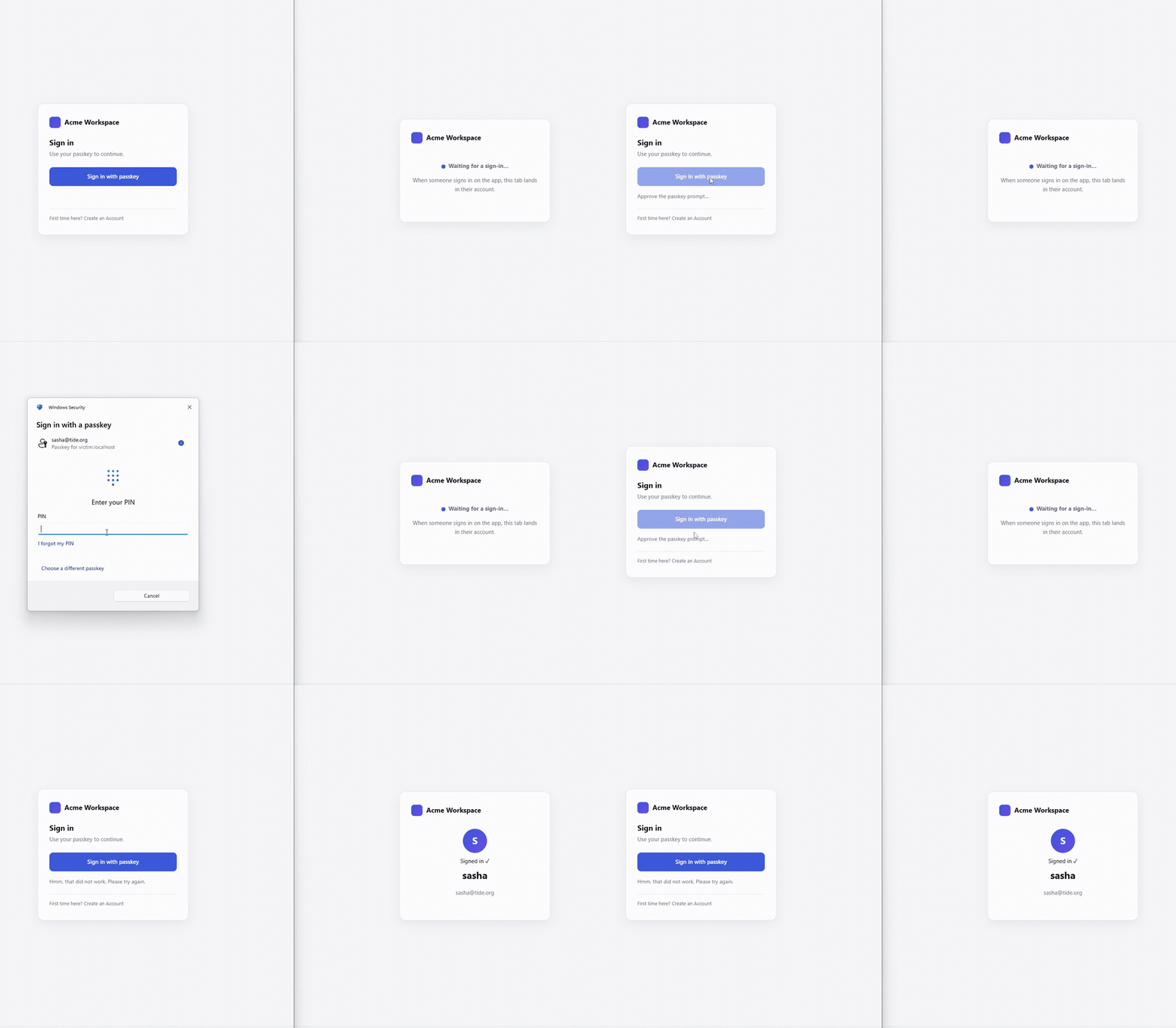\r\n\r\n## Authentication and session security\r\n\r\nBy design, the hardware protection of a passkey does not extend to the application session. WebAuthn provides no binding between the authenticator that approved the login and the subsequent session use.\r\n\r\n```comment\r\n---\r\ntitle: ByPasskey\r\n---\r\nsequenceDiagram\r\n actor V as Victim\r\n box Origin domain\r\n participant VP as Compromised
frontend\r\n participant AP as Relying Party\r\n end\r\n actor A as Attacker\r\n\r\n A <<->> AP: Get challenge\r\n V ->> VP: Login\r\n A <<->> VP: Swap challenge\r\n VP <<->> V: Passkey\r\n VP ->> A: assertion\r\n VP ->> V: Fail\r\n AP <<->> A: Welcome, Victim!\r\n```\r\n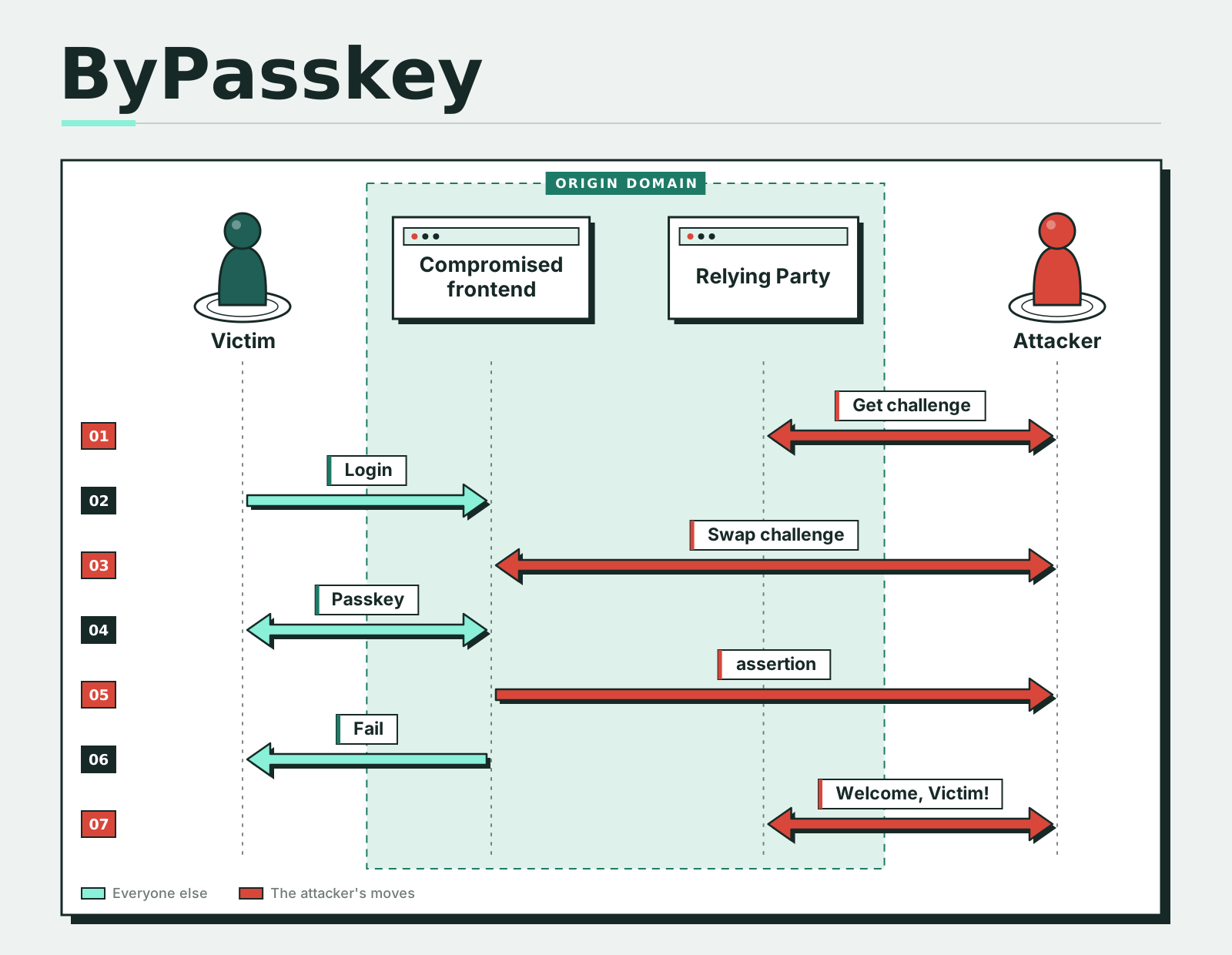\r\n\r\n[WebAuthn explicitly recognizes the risks of code injection on a trusted origin](https://www.w3.org/TR/webauthn-3/#sctn-code-injection). The deliberate separation between authentication and session binding exposes a significant limitation in WebAuthn's security guarantees. This attack demonstrates how easily it can be exploited, without needing to compromise the authentication key.\r\n \r\n## Origin compromise is a relevant threat assumption\r\n\r\nThe malicious code this attack requires can arrive through cross-site scripting, compromised dependencies, or privileged access to application code, all long treated as out of scope for authentication. Optimizely shows how difficult that exclusion is to defend. The injected code [ran on every page](https://blog.report-uri.com/worlds-largest-brands-infected-with-malware-via-optimizely/) that loaded an affected snippet, and wherever such a snippet loads on a sign-in page, that is enough to relay passkey logins.\r\n\r\nWeeks earlier, [PHP2Shell](https://access.redhat.com/security/vulnerabilities/RHSB-2026-013) exposed servers to unauthenticated code execution, and [eMudhra](https://bugzilla.mozilla.org/show_bug.cgi?id=2083449) exposed recoverable private keys in trusted certificate infrastructure. To our knowledge, this relay has not yet been used in the wild, but excluding origin compromise from a protocol's guarantees does not remove the need to address it in the wider security architecture.\r\n\r\n## Why session defenses do not help\r\n\r\nCommon session protections such as HttpOnly cookies do not help, because the session is created in the attacker's browser and nothing is taken from the victim's. Chrome's [Device Bound Session Credentials](https://developer.chrome.com/docs/web-platform/device-bound-session-credentials) bind a session to the browser that completes the login, which in this attack is the attacker's. Having the passkey sign a page-supplied session key fails similarly, since a compromised page can supply the attacker's key. Removing the malicious script does not revoke sessions created while it was active.\r\n\r\n## Binding authentication to session use\r\n\r\nTo close this gap, the missing requirement is **continuity of binding**: a verifiable connection between authentication and the subsequent use of the authority it creates.\r\n\r\nOne approach that would close it is for the authenticator to generate a protected session key during authentication and include its public key in the signed response. The server binds the session to that key and requires fresh proofs when the session is used. Such an approach would require extending the WebAuthn API like this:\r\n\r\n```comment\r\n---\r\ntitle: ByPasskey - DPoP extension\r\n---\r\nsequenceDiagram\r\n actor V as Victim\r\n participant AU as Authenticator\r\n box Origin domain\r\n participant VP as Compromised
frontend\r\n participant AP as Relying Party /
IdP\r\n end\r\n participant S as Attacker server\r\n actor A as Attacker\r\n\r\n Note over V, A: Attacker arms, in its own tab of the site\r\n A ->>+ AP: Login start\r\n AP -->> A: challenge\r\n A ->>+ S: challenge\r\n\r\n Note over V, A: Victim tries to log in, signs the attacker's challenge\r\n V ->> VP: Login\r\n VP ->> S: fetch challenge\r\n S -->> VP: challenge\r\n VP ->> AU: Passkey\r\n AU ->> V: authenticate\r\n V -->> AU: biometrics\r\n AU ->> AU: mint session key,
put its pubkey in signed authData\r\n AU -->> VP: assertion\r\n VP ->> S: assertion\r\n VP ->> V: Fail\r\n\r\n Note over V, A: Attacker finishes the login\r\n S -->>- A: assertion\r\n A ->> AP: Login finish\r\n AP -->>- A: access_token (bound to session key)\r\n\r\n Note over V, A: Attacker tries to use it, and is stuck\r\n A ->> AP: /api/me\r\n AP --x A: 401, no proof\r\n```\r\n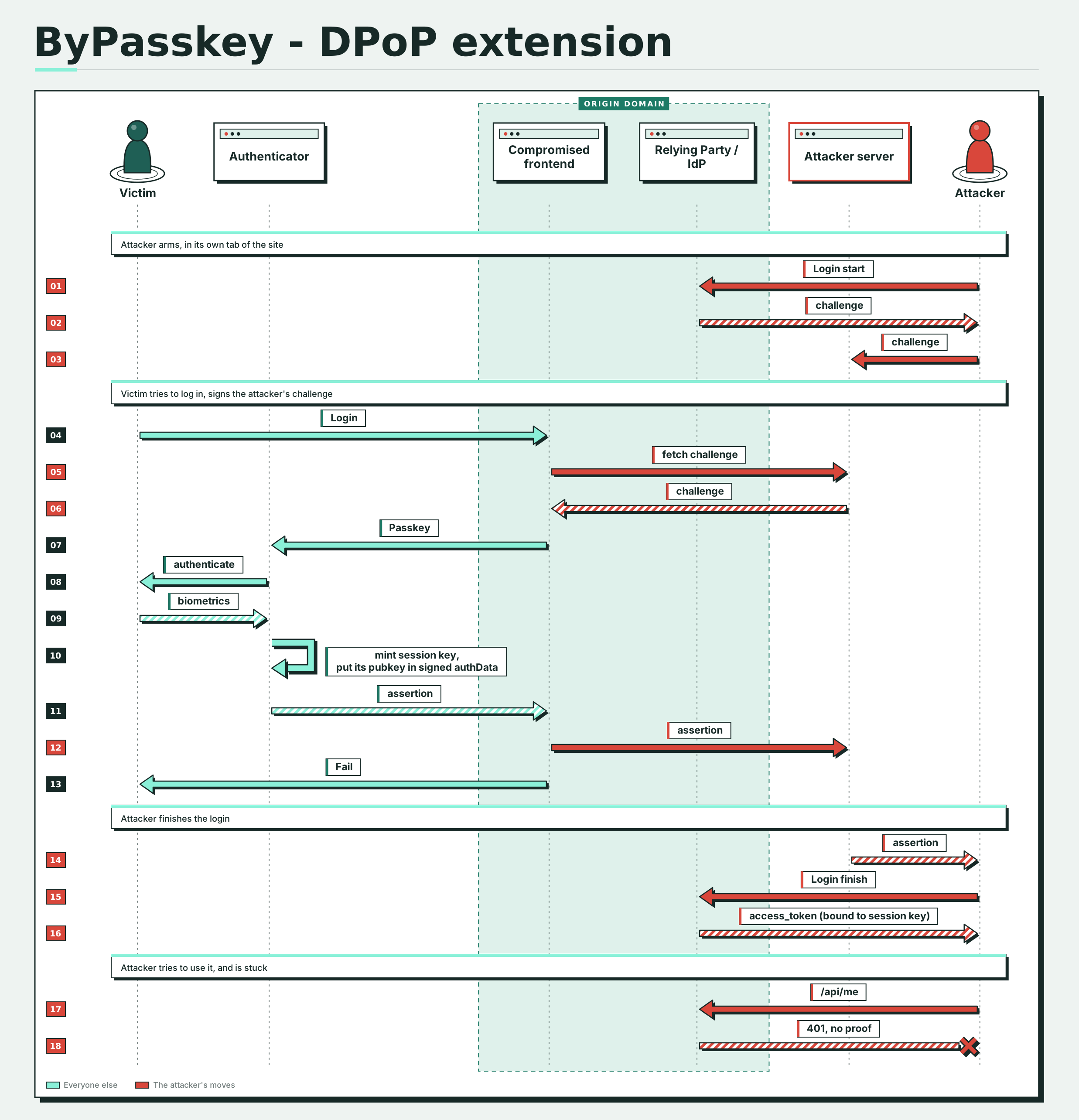\r\n\r\nThe [demo](https://github.com/tide-foundation/ByPasskey) prototypes it with a simulated authenticator. Real support would require work through standards committees.\r\n\r\nEven then, an actively compromised client may still request or relay valid operations. Session binding alone limits independent reuse of captured credentials; it does not eliminate misuse through that client.\r\n\r\n## Continuity in TideCloak\r\n\r\n[Tide](https://tide.org/tidecloak) implements session binding throughout a broader set of security operations.\r\n\r\nIts [BYOiD authentication](https://tide.org/whitepaper/byoid/cmk-authentication) establishes device-bound session keys during authentication. [Signed delegation](https://tide.org/whitepaper/authority-in-action) binds permissions for protected cryptographic operations to that session, while [end-to-end encryption](https://tide.org/whitepaper/authority-in-action/hermetic-e2ee) binds data decryption to that same session. A delegation token alone is insufficient without the corresponding session key. While Tide can't prevent a compromised client from relaying malicious operations, it offers a [verifiable trust boundary](https://tide.org/whitepaper/client-architecture) to detect it.\r\n\r\n[TideCloak provides these capabilities in an existing identity platform](https://tide.org/whitepaper/tidecloak-integration). Enforced [DPoP](https://docs.tide.org/Core-Concepts/dpop) extends key binding to application tokens, and distributed signing reduces reliance on any single server or human operator.\r\n\r\nFor operations covered by these controls, TideCloak provides a stronger continuity model than passkey authentication followed by a bearer session. Authentication, delegated authority and protected data access remain tied to session keys.\r\n\r\nToday, passkey deployments need equivalent continuity to support their broader claim about \"best of breed\" account security.","html":""}