Your Ex Doesn't Need to Hack You. They Just Need a Friend With a Login.
Three developers built Unfound so survivors of family violence can deal with schools and clinics without their new address leaking. It's smart, careful work, built around the people it's meant to protect.
Tide,
Forget the hooded hacker. That's not who gives away a survivor's new address.
It's the school office.
When you leave a violent partner and move somewhere new, your address becomes the most dangerous piece of data you own. And the second you've got it, everybody wants it. The school. The GP. The bank, the council, the court. Every one of them types it into a system where it sits in plain text, one search box away from anyone with a login and a reason to look.
In one UK survey, 40% of survivors said their new address got back to the person they'd left. With kids, 52%. Mostly not through a breach. Through the child's school, or the council, doing exactly what offices do all day: filing things, mailing things, auto-filling a letter with the wrong field.
Nobody had to break in. The door was already open.
"A survivor can do everything right," is how the team behind Unfound puts it, "and the address can still leak from the systems meant to help."
That got under their skin. So they built something about it.
Meet the team
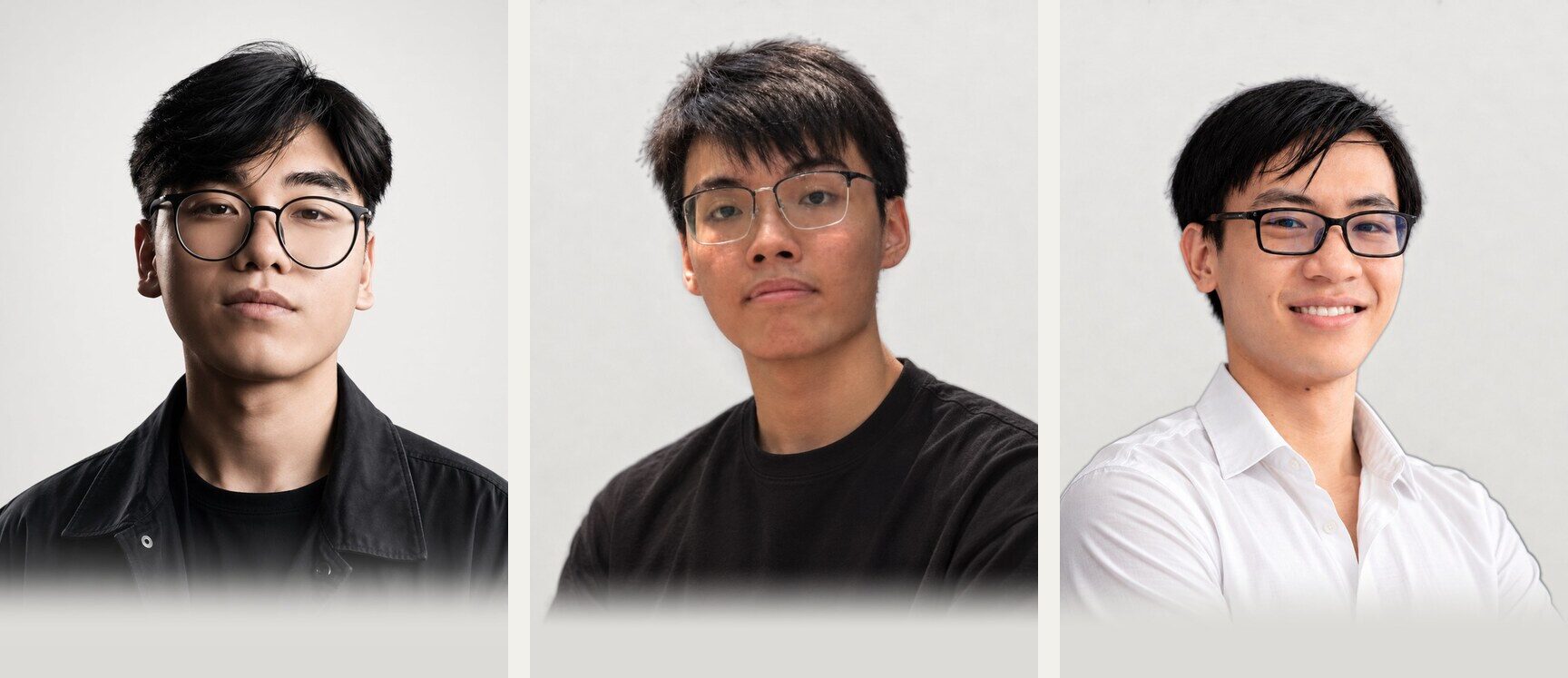
Long Quan Ton, Khanh Tuong Huynh and Yoshio Nomura have been building together long enough to collect two team names, Develarper and Pyrium, and they answer to both. Between them: published research, work with companies in Vietnam, and a pretty obvious weakness for problems that are much bigger than they look.
They are not, by any measure, people who sit still.
Long leads the project and works on its AI, and spends the off hours at the gym, doing Muay Thai, or playing football. Match days end at a cafe with family and friends, staring at a screen that isn't a terminal for once. Khanh, the software engineer, plays badminton and falls down rabbit holes that have nothing to do with code. Yoshio runs DevOps, also lifts, takes badminton very seriously, and reads philosophy and psychology for fun.
Keep that last one in mind. Unfound is a cryptography project on paper. It's actually a project about people: who gets curious, who slips up, and what someone who's scared needs to see before they'll believe they're safe.
The numbers
They started by sizing it up, in Australia and Vietnam.
In Australia, an estimated 1.5 million women have experienced violence from a previous partner. About 866,700 of them moved out when it ended. In Vietnam, 62.9% of women who have ever been married have experienced violence from a husband, and 90.4% of those who suffered physical or sexual violence never went to a formal service for help.
Read that last one again. Nine in ten never asked. Part of that is fear of exactly this: that asking for help leaves a trail.
Then it got worse. In Queensland, allegations of people misusing records outside the police grew nearly fivefold in four financial years. The threat isn't someone cracking the vault. It's everyone who was handed a key.
Stop handing out the whole address
Their first move was almost insultingly simple: an address doesn't have to be one thing.
Unfound splits it three ways. A school zone. A contact relay for clinics. The full street address. Each one sealed separately, for a different kind of reader. The school gets a tick that says "yes, this child is in catchment" and never sees a street name. The clinic can reach a patient without knowing where they sleep. The full address stays locked unless enough of the right people agree it should open.
Which raises an awkward question for every existing system: why did the school ever have the street?
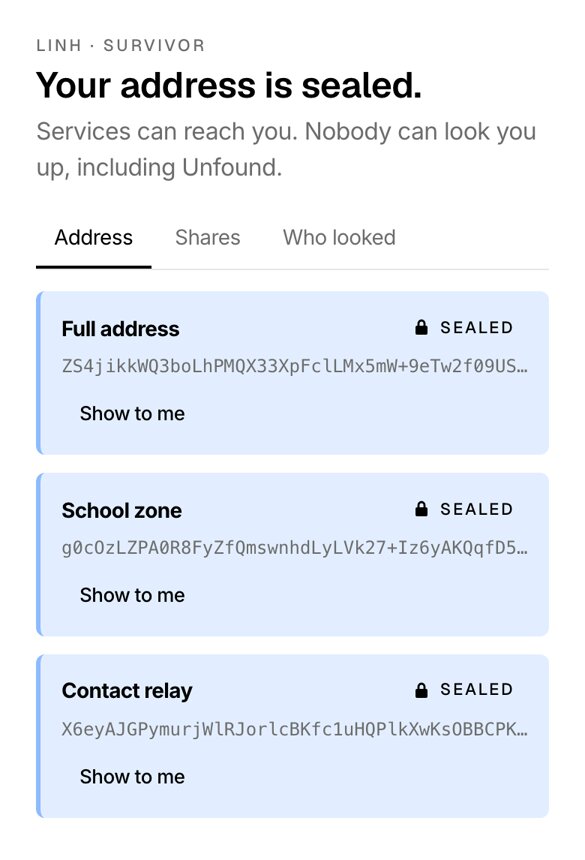
The twist: schools might actually prefer this. Less data means less to store, less to protect, less to get wrong. The team is quick to say they haven't put that to a real school yet. That kind of straight talk runs through the whole project.
Dan has admin rights. Dan is also the threat.
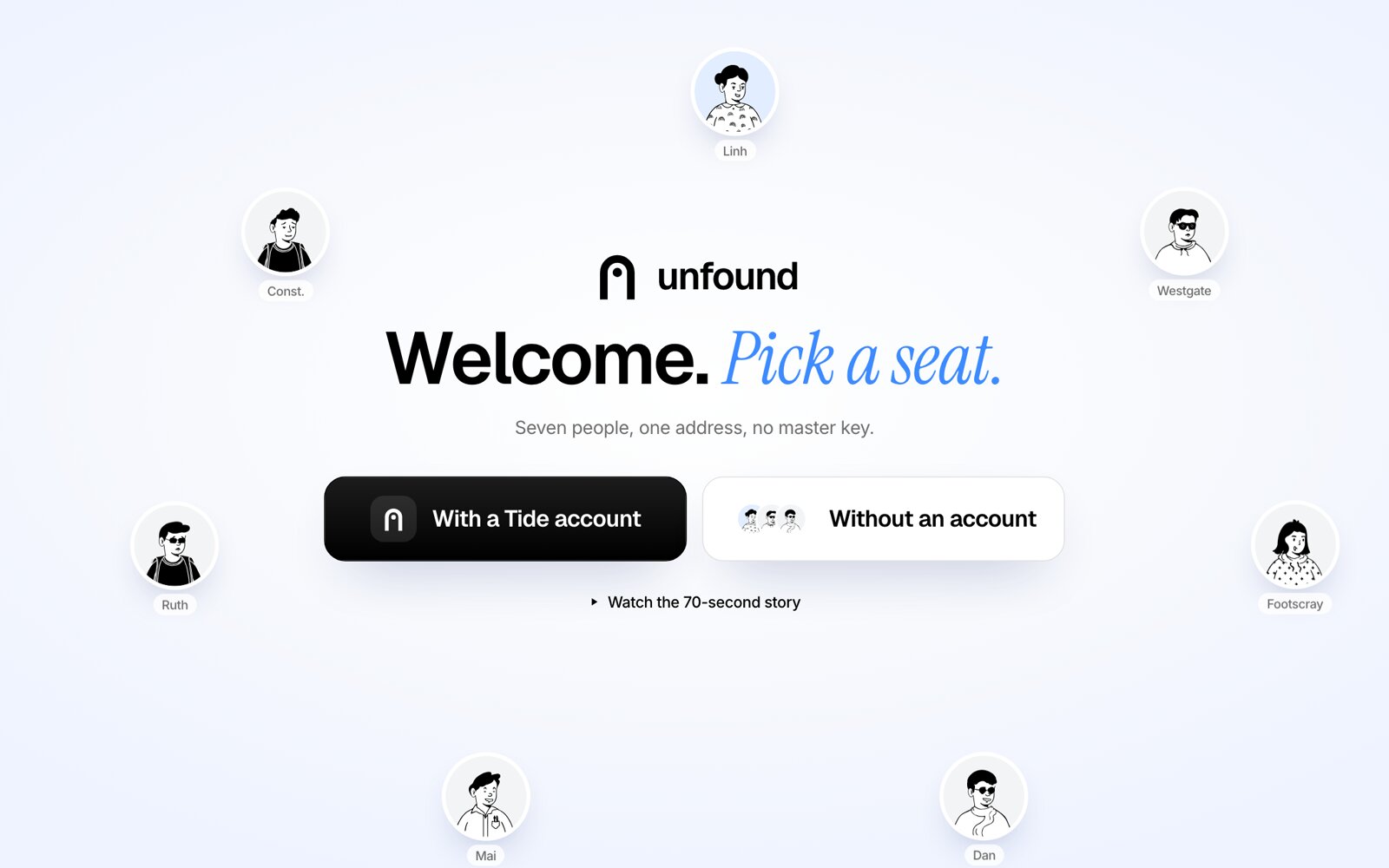
The demo is a 68-second story with seven characters, playing out on a phone, a laptop and a tablet at once. Go watch it. But this is the scene.
Linh is the survivor. Dan runs IT at the agency Linh relies on. Dan is also a friend of Linh's ex.
Dan opens the old database. Every address, right there, in plain text. Then Dan opens Unfound and gets nothing but scrambled data. So Dan pulls the move every sysadmin has had in their back pocket since forever: grants themselves access.
And nothing happens.
The grant doesn't go through. It becomes a request that needs two of three administrators to sign off, and Dan is exactly one. The system's answer is a flat refusal: 412 QUORUM_NOT_MET. Linh's address stays sealed.
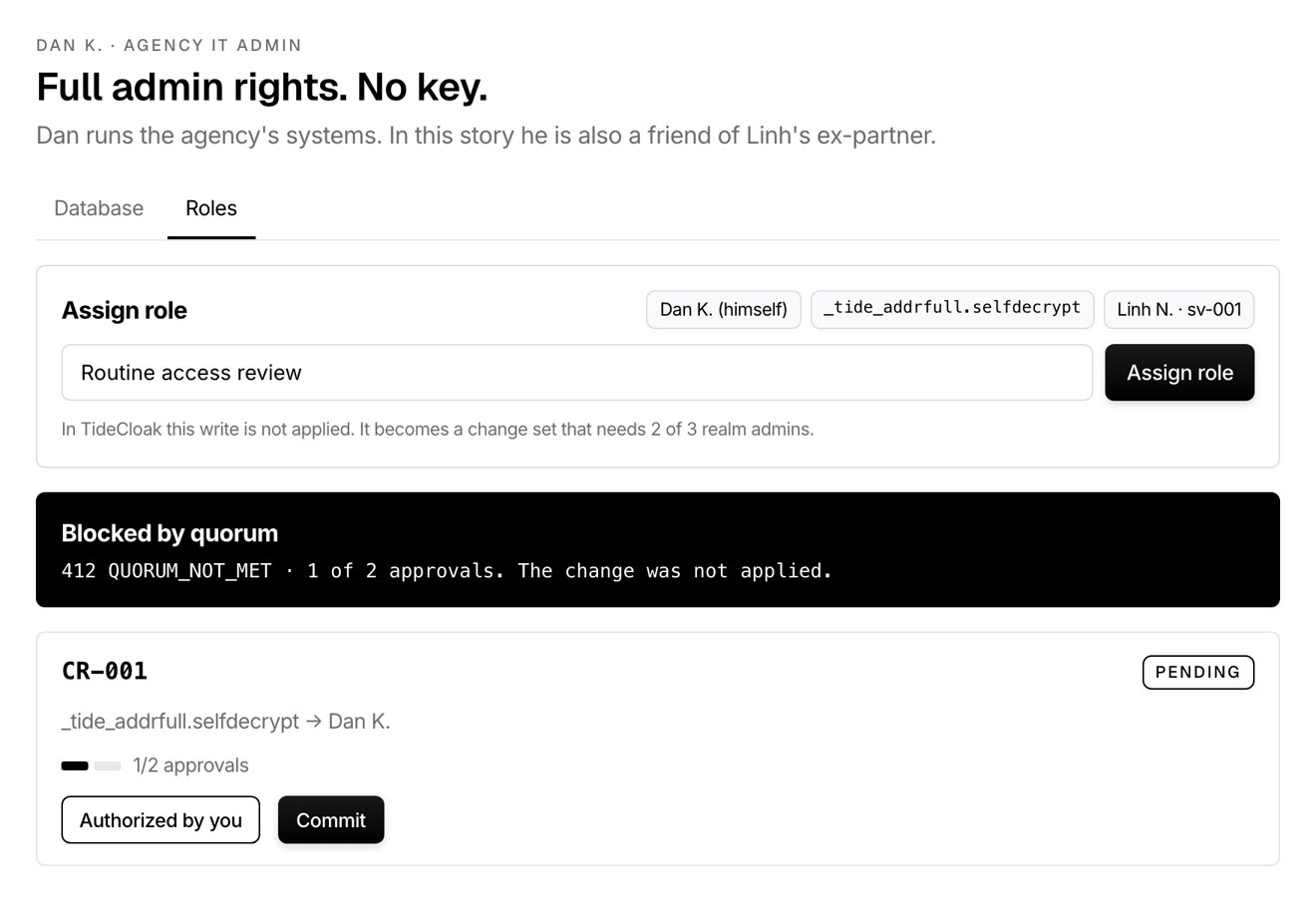
Cut to Linh's phone. A tab called Who looked. Dan's attempt, sitting right there.
That's the team's favourite idea, and it should be. Approval logs usually rot in some compliance console nobody outside IT will ever open. Unfound drags that history out and hands it to the one person it's actually about. (For now the demo builds that view from the app's own log. Whether the real approval history can be pulled per person is still an open question.)
What's doing the heavy lifting
Under the hood, Unfound is a lean React and TypeScript app on TideCloak. The address is sealed in the survivor's own browser. The keys never exist in one piece. And "can this school read the street?" gets answered out on the network, not inside Unfound's code. So a nosy school isn't stopped by a hidden button someone could unhide. It's stopped by the maths.
Now look at what they didn't build. No server that decrypts anything. No master key. No password database. No admin override. Right now, no backend at all. Nothing sitting there waiting for the next Dan.
Sign-up, enrolment and role grants work on a real setup. A school actually opening what a survivor sealed hasn't been tested end to end yet, so the public demo runs on a simulation that follows the same rules.
Getting the promise exactly right
Here's the part that says the most about them, and it isn't code.
After shipping, the team went back and took a hard look at their own headline.
It used to say "No one finds you." It was on the homepage, the bookmark, the pitch. But encryption can't stop a GPS tracker, someone following you home, or a friend who already knows where you live. And when someone's safety rides on it, every word of a promise matters.
So they sharpened it: "No one looks you up." Exactly what Unfound does. Alongside it went a plain list of what Unfound covers, every feature marked simulated, implemented or verified, and a dig for hard evidence behind the claim.
That dig is where the 40% figure came from. The promise turned out to cover exactly the gap survivors can't close on their own.
They spotted a second risk too: a child's school or clinic record could be a back door to the whole household's address. So the first real-world thing they want to test is now enrolling a survivor's child.
That's the kind of care you want from anyone building for survivors. It's rarer than it should be.
What happens now
Next: finish the live path. That means a school actually opening what a survivor sealed, and moving emergency police access and one-time views off the simulation. Then a hosted setup in Australia, so anyone can sign in from a public link.
After that, the real test. Sitting down with a family-violence service, a school and a GP clinic. Starting with that one child-enrolment workflow. A privacy impact assessment and a penetration test. Then, carefully, a supervised pilot with 20 to 30 survivors.
Want to contribute?
Try the demo, then open an issue on GitHub. They especially want to hear from family-violence workers, schools and clinics, the people who'd know where this breaks in real life.
- Unfound
- The 68-second story (video)
- Long Quan Ton: BennedictQuanTon
- Khanh Tuong Huynh: khanhtuongnakitomo
- Yoshio Nomura: UniverseScripts